Boiler losing pressure? What to check before you call
A gauge that keeps drifting below 1 bar is one of the most common calls Mike gets. Here's what it means and what you can safely check yourself.
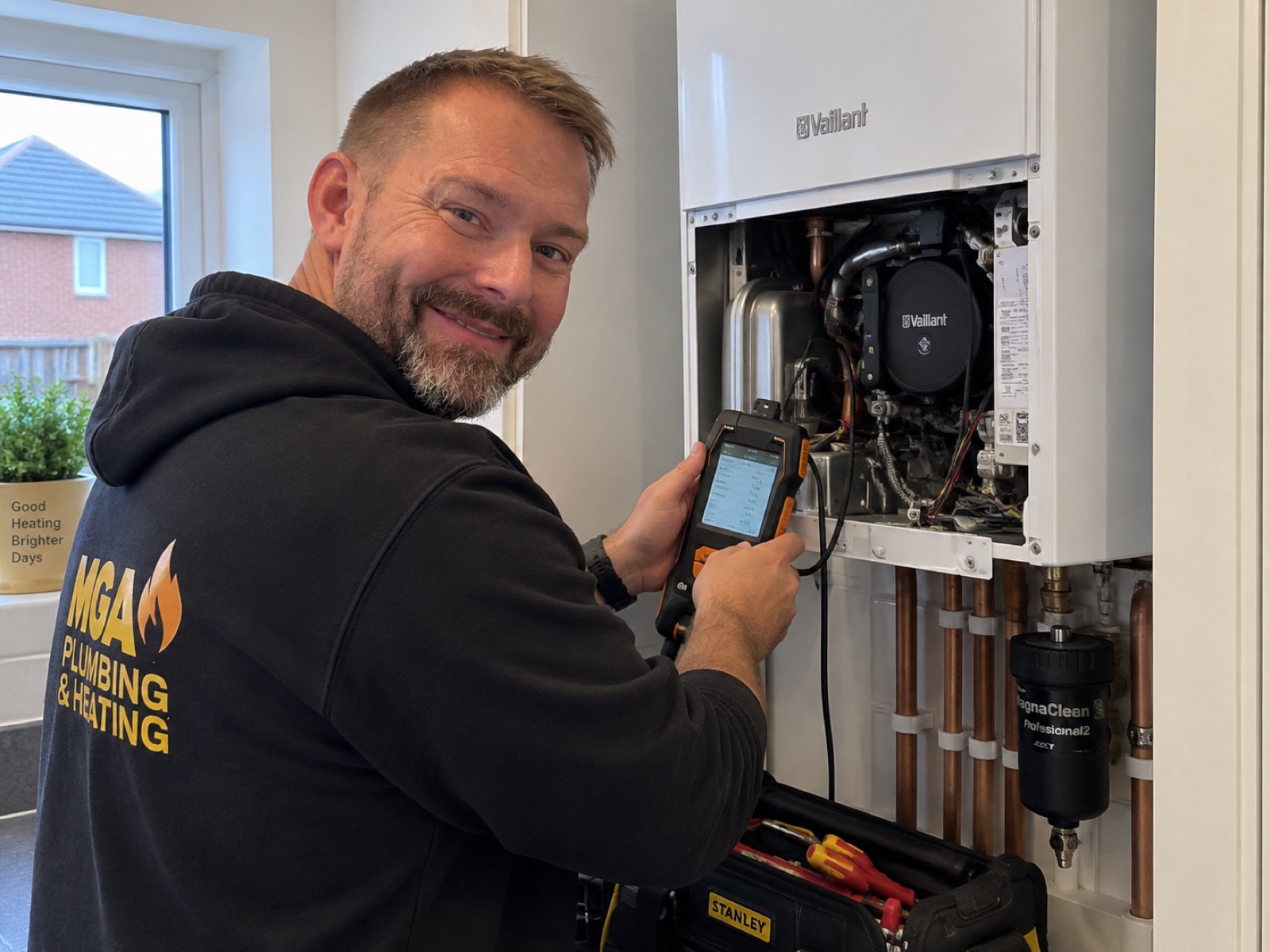
Most combi boilers like to sit between 1 and 1.5 bar when the heating is cold. If yours keeps dropping, water is leaving the system somewhere, and the boiler will eventually lock out to protect itself.
1. Look for the obvious leak
Check under every radiator, around the valves, along any visible pipework and under the boiler itself. Look for drips, damp carpet or crusty white or green marks on fittings. A slow weep is easy to miss.
2. Check the pressure relief pipe
There's usually a small copper pipe running from the boiler to the outside wall. If it's dripping, the pressure relief valve may be letting go. That's often caused by an expansion vessel that has lost its charge.
3. Did you bleed the radiators recently?
Bleeding radiators lets air out, and the pressure drops with it. Topping up once afterwards is normal. Needing to top up every week isn't.
4. Top up, once
Your manual shows how to use the filling loop. Fill slowly to about 1.2 bar with the heating off, close both valves fully, and watch the gauge for a few days.
If the pressure keeps falling, or you can't find the filling loop, stop there. Repeated topping up adds fresh oxygen to the system and speeds up corrosion.
When to call Mike
If you're topping up more than once a month, you've found water near electrics, or the boiler is locking out, it's time for a proper look. Send a photo of the gauge and the pipework under the boiler on WhatsApp. It often saves a trip.

Leak, boiler or bathroom? Call Mike.
Straight answers, fair prices, and a local engineer who turns up when he says he will. Send a photo on WhatsApp for the quickest reply.